Warning: Cannot modify header information - headers already sent by (output started at /home/kusat/www/spectrum/promax-tv-explorer-iiplus.php:1) in /home/kusat/www/spectrum/promax-tv-explorer-iiplus.php on line 7
TV Explorer II+ (Prodig 7A)
The Promax TV Explorer II+ incorporates the latest Worldwide satellite and terrestrial standards! It has been designed for the installation, maintenance and surveillance of terrestrial, satellite, cable and portable TV systems. This is perhaps the easiest to use spectrum analyzer on the market today with such an advanced set of features.
Overview
The TV Explorer II incorporate a transflective 6.5" color LCD with a 16:9 aspect ratio.
A transflective screen combines the advantages of transmissive and reflective displays. Transmissive displays are illuminated from behind (ideal for indoor use), while reflective displays use the reflection of external light such as the Sun (ideal for outdoor use). The result is an stunning picture indoors and outdoors.
The large 6.5" screen makes it easy to see even small details and with an operating range of -40°C to 80°C (beyond the instrument's operating range), so you can be assured of a stunning picture regardless of the environment around you.
|
The Promax Explorer's compact and rugged construction makes it ideal for field use. Its 6.5" color LCD screen shows all measurement results and can also display the picture of analogue and digital channels.
This instrument is compatible with the new DVB-S2 format in QPSK and 8PSK modulation and it can analyzer off-air digital broadcasting (COFDM encapsulating standard of HDTV programming) as well as digital cable (QAM).
For more information, you can download the TV Explorer II PDF brochure, read an article published by Tele Satellite in August 2007 about this instrument and watch Promax videos on YouTube.
All our Promax spectrum analyzers sold in the North American market come pre-loaded with the latest North American Ku-Band transponder maps of FSS and DBS satellites from 129°W, all the way to 61.5°W.
 the TV Explorer II+ online. the TV Explorer II+ online.
|
|
 Built for all DVB standards!
The Prodig 7A was built to support all DVB standards, namely: DVB-S, DVB-S2, DVB-C, DVB-T and DVB-H.
In addition to the Explorer II, the II+ has the following features:
- 1 Gig of memory for data captures and streaming video captures (128Mb on the II).
- Common Interface (CI) slot for access to scrambled content.
- MERGRAM and SPECTROGRAM functions
Mergram and Spectrogram Functions
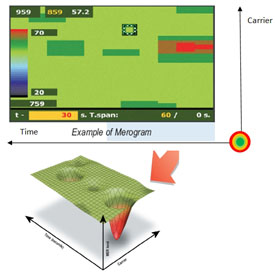
The MERGRAM function is an evolution of the MER by carrier function that exploits the enormous processing power of the TV Explorer II+ meter to show in a live display, how MER values for each carrier (shown in different colors) change with the time in a DVB-T/H multiplex.
The SPECTROGRAM function is an evolution of the spectrum analyzer function that shows similarly how the peak levels of any signal under test vary with time.
Constellation Function
| The constellation diagram is a graphic representation (called I-Q) of the digital symbols received over a period of time.
There are different types of constellation diagrams for the different modulation modes. With the TV EXPLORER II it is possible to display constellations for DVB-T/H, DVB-C, DVB-S and DVB-S2 signals.
In case of an ideal transmission channel, free of noise and interferences, all symbols are recognized by the demodulator without mistakes. In this case, they are represented in the constellation diagram as well defined points hitting in the same area and forming a clear dot.
Noise and impairments cause the demodulator to not always read the symbols correctly. In this case the hits disperse and create different shapes that at the end will allow to determine at a glance the type of noise in the signal.
Every modulation type is represented differently. A DVB-C 16QAM signal is represented on the screen by a total of 16 different zones, and a DVB-C 64QAM is represented on the screen by a total of 64 different zones.
The constellation shows in different colors the density of hits and includes zooming and scrolling possibilities and also a clear button to clean the picture. QAM 256 constellation. |

[] |
Easy to use
The Promax TV Explorer II+ is easy to use. Most functions can be accessed within the touch of a single key and these functions can then be controlled via the push dial and the arrow-keys. There are no complicated sub menus to navigate to get where you want...
Example: Hit the S/T button to switch between Satellite and Terrestrial or the D/A button to switch between Digital and Analog.
First of its kind, the TV Explorer also includes an Auto-Identification and an Explore key to search for information about a particular channel/frequency or to scan all bands to search for signals.
Auto Identification
The TV Explorer II+ is designed for use in terrestrial, satellite and cable-tv environments in both digital and analogue.
By hitting the Explore key, the instrument will search for any type of signal available and display its parameters such as Standard (Pal / Secam / NTSC), modulation type (QAM / QPSK / COFDM), transponder parameters (Symbol Rate, FEC) and channel parameters (PIDs).
Once transponders and channels are identified, the Explorer creates a registry of all the available channels for easy navigation of the entire network by the installer. Sessions can be stored and recalled at any time, to save time and organize your work.
You can also search for specific signals by manually entering the channel parameters.
Signal Measurement
All measures about a particular channel / transponder can be seen in one screen.
The Promax TV Explorer II can also measure signal in the 5MHz-65MHz band to troubleshoot of the Return Path in modern cable systems. Combined with the NG-281 / NG-282 Noise Generator or the RP-250 Multicarrier generator, you can insert multiple carriers in your cable system at frequencies ranging from 5MHz to 2500MHz (3x UHF / VHF, 3x SAT, 1x Sub Band, 1x ISM with the RP-250).
The display adapts itself to the type of signal being measured:
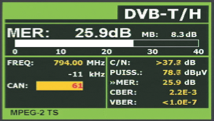 |
DVB-H / DVB-H |
Power, SER, VBER, MER, C/N, Noise Margin |
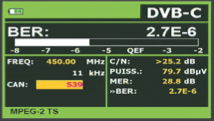 |
DVB-C |
Power, BER, MER, C/N, Noise Margin |
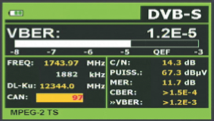 |
DVB-S (QPSK) |
Power, CBER, VBER, MER, C/N, Noise Margin |
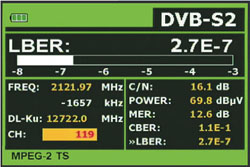 |
DVB-S2 (QPSK/8PSK) |
Power, CBER, MER, C/N, PER and LBER |
Spectrum Display
 To give the installer absolute control over his work, the Promax TV Explorer is also a powerful spectrum analyzer. This function is easy to use and allows the installer to control key parameters such as resolution, sensitivity and sweep time.
The Promax TV Explorer comes with several user-selectable color models or "skins". There are a number of possible combinations between colors and lines. Skins can help to improve the display in different light conditions and can make the user feel more comfortable with the instrument.
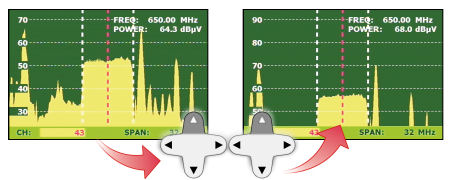 |
The 'UP-DOWN' arrows set the reference level.
Hit the 'UP' arrow and the reference level is increased by 10 dB.
Hit the "DOWN" arrow and the reference level is reduced by 10 dB. |
Signal Demodulation
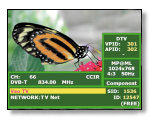
If you are locked on a digital satellite, cable or terrestrial signal, the Promax TV Explorer will display the channel whether it is free-to-air or scrambled* and the following information when the Demodulate key is pressed:
|
Channel Information:
- Channel number and channel plan
- MPEG-2 detection flag
- Service
- Network Identification
- Video PID
- Audio PID
- Picture format
- SID
- ID
- Free or Encrypted
- Type of signal (DVB-T / C / S)
|
Portability
The Promax TV Explorer is small and rugged. It weights about 2Kg (5Lb) including the battery, which makes it ideal for installers that must climb ladders and carry lots of equipment on the job.
The Promax TV Explorer comes complete with a carrying bag which allows you to strap it around your waist or shoulder and protects it from shocks and the elements.
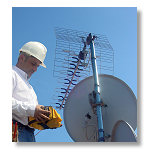
Antenna Installation
|
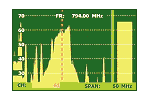 The Promax TV Explorer has an "Easy antenna alignment" function which give a very fast spectrum display, ideal to locate hard to find satellite signals. Once the signal is found, you may peak your antenna using the same spectrum display or you can concentrate on the signal bar located on the right side of the screen. The Promax TV Explorer has an "Easy antenna alignment" function which give a very fast spectrum display, ideal to locate hard to find satellite signals. Once the signal is found, you may peak your antenna using the same spectrum display or you can concentrate on the signal bar located on the right side of the screen.
The Promax TV Explorer allows you to control all types antennas and LNBs (13V/18V switching for polarity selection, 22Khz tone, DiSEqC control, etc.). |
Battery
The Promax TV Explorer uses a high performance Lithium-ion battery. This batteries can provide a Max. operational time of over 4 hours. The battery can be charged in 2 to 3 hours and does not suffer from memory related problems common with Ni-Cad instruments.
A battery charge indicator ( ) lets you know when it's time to plug the instrument in the A/C for extended use or re-charge the battery.
Light Sensor
 The Promax TV Explorer would not be complete with another unique feature: a light sensor.
In addition to its extra-bright LCD display (320 candles / square cm), the Promax TV Explorer includes a light sensor that can automatically adjust the contrast and brightness of the screen.
This is not only useful to always get optimal visibility of the screen, but it can also extend the battery life of your instrument.
Specifications
See below for a full set of specifications for the Promax TV Explorer II+:
| Promax TV Explorer II+ (Prodig 7A) |
| Frequency Range |
Terrestrial |
5-1000MHz |
| Satellite |
950-2150MHz |
| Resolution |
Terrestrial |
50 kHz |
| Satellite |
200 kHz |
| RF Input |
Impedance |
75Ω |
| Connector |
F, BNC, RCA |
| Max Signal |
130 dBµV |
| Max Voltage |
DC to 100Hz, 30 Vrms |
| Power Range |
DVB-T |
45 dBµV to 100 dBµV |
| DVB-C |
45 dBµV to 110 dBµV |
| DVB-S |
44 dBµV to 114 dBµV |
| DVB-S2 |
44 dBµV to 114 dBµV |
| Level Measurement |
Terrestrial |
10 dBµV to 130 dBMV (3.16 µV to 3.16 V) |
| Satellite |
30 dBµV to 130 dBMV (31.6 µV to 3.16 V) |
| Measurement |
Units |
dBµV, dBmV, dBm |
| Measurement Bandwidth |
Terrestrial |
230 kHZ |
| Satellite |
4 MHz |
| Max. band ripple 1 dB |
| Measurement Accuracy |
Terrestrial |
± 1.5dB |
| Satellite |
± 2.5dB |
| Analog Measures |
Terrestrial |
Level, Video/Audio, C/N |
| Satellite |
Level, C/N, Power (Digital) |
| Resolution Bandwidth |
Terrestrial |
1 MHz, 230 kHz |
| Satellite |
4 MHz, 1 MHz |
| Display span |
Terrestrial |
Full Band, 500, 200, 100, 50, 32, 16, 8 MHz |
| Satellite |
Full Band, 500, 200, 100, 50, 32, 16 MHz |
| Display Marker |
|
Single, with Freq. and Level readout (power readout in digital) |
| Digital Measurements |
DVB-H |
Power, SER, VBER, MER, C/N, Noise Margin |
| DVB-T |
Power, SER, VBER, MER, C/N, Noise Margin |
| DVB-C |
Power, BER, MER, C/N, Noise Margin |
| DVB-S (QPSK) |
Power, CBER, VBER, MER, C/N, Noise Margin |
| DVB-S2 (QPSK/8PSK) |
Power, CBER, MER, C/N, PER and LBER |
| Constellation Diagram |
I-Q Graph |
DVB-S and DVB-S2, I-Q graph. |
| Digital Modes |
DVB-T/H |
Carriers 2k / 4k/ 8k. Guard Interval 1/4, 1/8, 1/16, 1/32. Code Rate 1/2, 2/3, 3/4, 5/6, 7/8. Modulation QPSK, 16-QAM, 64-QAM. Spectral inversion: On/Off. Hierarchy Indicates hierarchy mode. Cell ID Transmitter station. TPS signalling Time slicing, symbol interleaver and MPE-FEC. |
| DVB-C |
1000 to 7000 kbauds, 16/32/64/128/256 QAM. |
| DVB-S |
2-45Mbps, 1/2-7/8 FEC |
| DVB-S2 |
2-33Mbps, 1/2-9/10 (QPSK), 2/3-9/10 (8PSK) |
| Video Demodulation |
Image & Sound |
480i, 576i video & audio for Analog terrestrial, DVB-S, S2, C, H, T channels |
| Video Format |
MPEG-2 (MP@ML) (Main Profile @ Main Level) |
| Information |
Service List, PIDs & Data rates for DVB-S, S2, C, H, T channels |
| Datalogger Function |
Analogue |
Level Video/Audio, C/N |
| Digital |
Frequency Offset, Mpeg-2 Detection, power, C/N, MER, CBER, VBER, LBER and noise margin |
| Storage Capacity |
1Gb |
| Physical |
Display |
6.5" TFT Screen, 16:9 & 4:3 ratios |
| System |
NTSC, PAL, SECAM |
| Video In/Out |
RCA, 1Vpp (75Ω) positive Video |
| Audio In/Out |
Scart with RCA Adapter |
| Speaker |
Built in |
| USB Port |
USB port with Serial Port Emulation for updates & calibration |
| Common Interface |
CI Slot for access to scrambled content (CI module & smart card not provided) |
| External device control (via RF Output) |
Voltage |
5/13/15/18/24 V |
| 22KHz |
0.6V ± 0.2V, 22 KHz ± 4 kHz |
| Maximum Power |
5W |
| DiSEqC |
DiSEqC 1.2 Standard |
| Power supply |
Internal Battery |
7.2 V 11 Ah Li-Ion battery |
| > 4.5 hrs in continuous mode |
| Charging time |
3 hours for >80% charge (device Off) |
| External requirement |
12 V |
| Consumption |
30 W |
| Auto power off |
Set by user |
| Environmental |
Temperature |
5° to 40° with auto-off in case of excess heat |
| Humidity |
Up to 80% @ 31°C, 50% @ 40°C |
| Altitude |
Up to 2000m |
| Dimensions |
230 (w) x 161 (h) x 76 (d) |
| Weight |
2.2 kg (without accessories) |
| Accessories |
Included |
10dB attenuator, F-BNC, F-DIN, F-F adapters, AC/DC Charger, Carrying bag (yellow), Belt (Black), Car charger. |
| Included |
Hard top Suitcase |
*: Scrambled channels require the presence of a CI decoder module and smart card with subscription.
 |
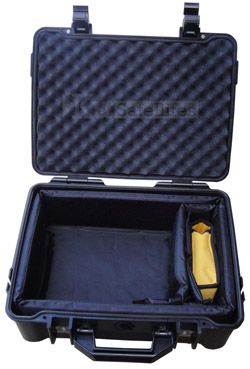 |
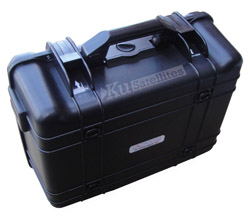
| Hard top transport suitcase |
